- AI Pulse
- Posts
- 😳 This AI Can Tell Where You Want to Go Before You Say It
😳 This AI Can Tell Where You Want to Go Before You Say It
Your navigator now understands you like a human and the implications might surprise you.

Rahul G. Iyer
December 07, 2025

In partnership with


Hello There!
Google is teaching Maps to hold real conversations while you drive, giving you landmark-based directions that feel almost human, and for you it means fewer wrong turns and more chances to pretend you have a personal chauffeur who never gets tired. Google is also dreaming up solar-powered data centers floating in space to feed AI’s energy hunger, and for you it means a future where even your toughest IT infrastructure issues might feel lighter than gravity itself. Meta, meanwhile, has bought a memory-capturing pendant that records and summarizes your day, and for you it means the possibility of skipping note taking entirely while quietly hoping your boss never buys one for performance reviews.
Here’s what’s shaping the future of AI today.
In today’s AI Pulse
📘 You.com – Find your highest-ROI AI use cases fast.
📺 Roku Ads Manager – Reach holiday shoppers where they’re streaming.
💼 HR Newsletter – Real HR advice that actually makes the job less lonely.
🗺️ Gemini – Makes Maps Smarter for Drivers.
☀️ Google – Explores Solar Space Data Centers.
🛍️ Meta – Acquires Limitless Wearable Memory Tech.
⚡ In AI Today – Quick Hits
The next wave of AI might not fold your laundry… but it could finally untangle your entire life.
Learn how to make every AI investment count.
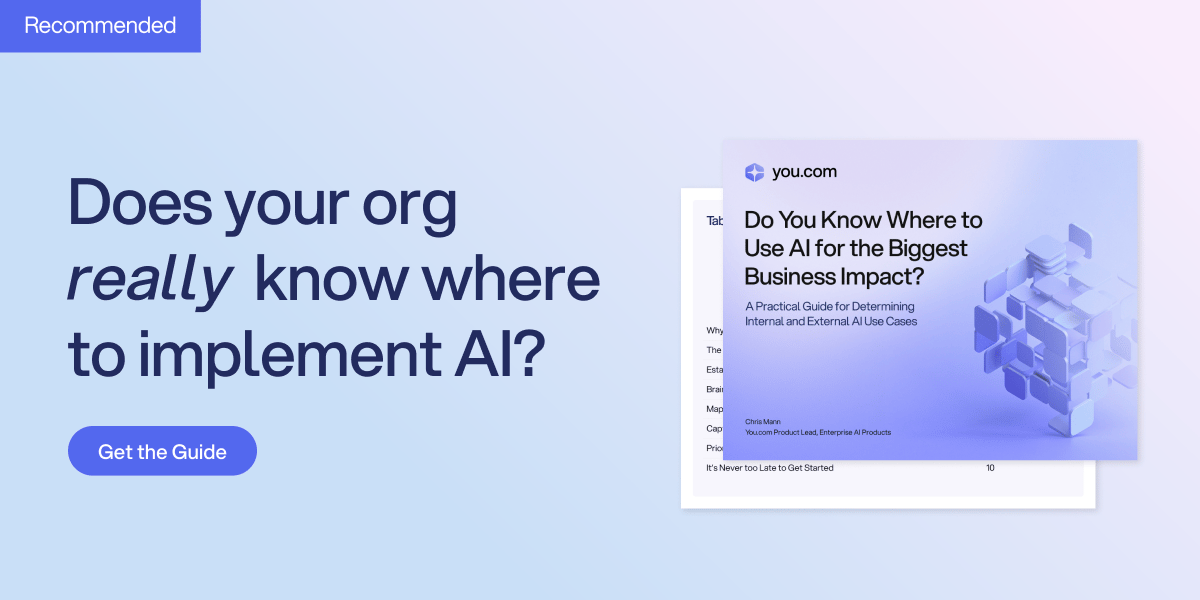
Successful AI transformation starts with deeply understanding your organization’s most critical use cases. We recommend this practical guide from You.com that walks through a proven framework to identify, prioritize, and document high-value AI opportunities.
In this AI Use Case Discovery Guide, you’ll learn how to:
Map internal workflows and customer journeys to pinpoint where AI can drive measurable ROI
Ask the right questions when it comes to AI use cases
Align cross-functional teams and stakeholders for a unified, scalable approach
Shoppers are adding to cart for the holidays

Over the next year, Roku predicts that 100% of the streaming audience will see ads. For growth marketers in 2026, CTV will remain an important “safe space” as AI creates widespread disruption in the search and social channels. Plus, easier access to self-serve CTV ad buying tools and targeting options will lead to a surge in locally-targeted streaming campaigns.
Read our guide to find out why growth marketers should make sure CTV is part of their 2026 media mix.

The best HR advice comes from those in the trenches. That’s what this is: real-world HR insights delivered in a newsletter from Hebba Youssef, a Chief People Officer who’s been there. Practical, real strategies with a dash of humor. Because HR shouldn’t be thankless—and you shouldn’t be alone in it.

Image Credit: AIGPE®
🧠The Pulse
Google integrated Gemini 3 into Google Maps, allowing hands‑free, conversational navigation. Drivers can get landmark‑based directions, ask follow‑up questions and request route changes without touching the screen. The update exemplifies how generative AI is infiltrating everyday products to simplify user interactions.
📌The Download
Hands-free AI navigation: Gemini 3 now powers natural-language directions inside Google Maps. Drivers can ask things like “Which exit after the gas station?” or “Turn left after what landmark?” and receive precise, contextual guidance without needing to look at the screen, improving safety and reducing distraction.
Understands real-world cues: The AI interprets landmarks, colloquial phrasing, and personal route habits. It can adjust paths based on traffic, user preferences, and situational context, making navigation feel more human and intuitive.
Rolling out globally: The feature is launching on both Android and iOS. It works alongside existing voice navigation and requires standard location permissions. Google highlights that conversations are processed for routing but not stored long-term.
Strategic move for Google: Integrating Gemini into Maps signals deeper AI expansion across Gmail, Docs, and more. It also strengthens Google’s position against Siri and rival navigation apps, though reliability remains critical for user trust.
💡What This Means for You
AI‑powered navigation promises convenience and safety, but you must remain aware of potential inaccuracies. Companies with driving fleets should trial the feature carefully and update training to include voice controls. Expect voice and AI interfaces to become standard across enterprise apps, transforming user expectations and workflows.

Image Credit: AIGPE®
🧠The Pulse
Fortune reports that Google CEO Sundar Pichai is eyeing space as the next frontier for AI infrastructure. The company’s Project Suncatcher will launch prototype satellites by the late 2027 to build solar‑powered data centers in orbit. Pichai believes extraterrestrial data centers could cut carbon emissions.
📌The Download
Google plans space data centers: Sundar Pichai told Fortune that Google’s Project Suncatcher aims to launch solar-powered satellites that run AI workloads in orbit, using uninterrupted sunlight to keep systems powered.
A push to cut AI’s energy cost: By shifting computation off-planet, Google hopes to reduce AI’s massive electricity demand and shrink its carbon footprint. A prototype satellite is expected to begin testing specialized AI hardware in the late 2020s.
Part of a larger infrastructure gamble: The report highlights Google’s wider US$40 billion investment in Texas data centers and warns that aggressive spending across the industry could create signs of an AI infrastructure bubble. Space-based compute is framed as a long-term experiment, not an immediate fix.
Huge hurdles remain: Radiation protection, cooling in vacuum, satellite maintenance and growing space-debris risks make the concept extremely challenging. Even so, the project shows how far tech giants are prepared to go to power next-generation AI.
💡What This Means for You
While cosmic data centers remain speculative, they signal the extreme measures companies consider to meet AI’s energy appetite. Businesses should anticipate rising costs for earthbound data centers and explore renewable energy partnerships. Regulatory frameworks may also evolve as space‑based computing becomes a serious consideration.

Image Credit: AIGPE®
🧠The Pulse
Meta has acquired Limitless, a start‑up selling an AI‑powered pendant that records and transcribes conversations. The move hints at Meta’s ambition to build AI‑enabled wearables that augment memory. Limitless will stop selling devices and require existing users to accept new privacy terms.
📌The Download
Meta buys Limitless tech: Limitless makes a pendant-style device that continuously captures conversations and uses machine learning to generate summaries of meetings and personal notes. Meta’s acquisition gives it direct access to this technology and the team behind it.
A well-funded AI startup: Limitless has raised more than US$33 million from major investors including Sam Altman and Andreessen Horowitz. After joining Meta, it will stop accepting new customers, and existing users must agree to updated privacy terms or discontinue use.
Powering Meta’s AI wearables vision: Meta plans to fold Limitless’s memory and summarization features into future AI wearables and assistants, potentially enhancing its AR glasses, smart rings, and other personal-AI devices.
Privacy concerns intensify: Constant audio capture raises alarms about consent, surveillance, and data safeguards. Meta says users will control recording and data will be encrypted, but regulators are likely to review these claims closely as Big Tech accelerates toward personal-memory AI.
💡What This Means for You
Expect AI‑enabled wearables to enter professional environments soon. They promise productivity gains, auto‑generated meeting notes and reminders, but raise privacy and compliance issues. Companies must set policies governing recording devices, obtain consent and evaluate vendor security. Missteps could breach confidentiality and damage trust among employees and clients.
IN AI TODAY - QUICK HITS
⚡Quick Hits (60‑Second News Sprint)
Short, sharp updates to keep your finger on the AI pulse.
Cohere CEO Says U.S. & Canada Will Win the AI Race vs China: Cohere CEO Aidan Gomez told Reuters NEXT that the U.S. and Canada will win the AI race because they excel at commercialising technologies. He said liberal democracies are unlikely to rely on Chinese AI for critical infrastructure. He contrasted his view with Nvidia CEO Jensen Huang’s claim that China is close behind.
Accenture & OpenAI Team Up to Train Tens of Thousands on ChatGPT Enterprise: OpenAI and Accenture will roll out ChatGPT Enterprise to tens of thousands of Accenture employees, pairing the tech with consulting expertise to build AI agents for clients. Reuters says the program spans multiple industries. The alliance accelerates enterprise adoption but demands significant training and governance.
That’s it for today’s AI Pulse!We’d love your feedback, what did you think of today’s issue? Your thoughts help us shape better, sharper updates every week. |
🙌 About Us
AI Pulse is the official newsletter by AIGPE™. Our mission: help professionals master Lean, Six Sigma, Project Management, and now AI, so you can deliver breakthroughs that stick.
Love this edition? Share it with one colleague and multiply the impact.
Have feedback? Hit reply, we read every note.
See you next week,
Team AIGPETM