- AI Pulse
- Posts
- 🚨 Is AI About to Rewrite Human DNA?
🚨 Is AI About to Rewrite Human DNA?
GPT-5 just shocked scientists with a real biology experiment

Rahul G. Iyer
December 18, 2025

In partnership with


Hello There!
AI just crossed into human biology as GPT-5 helped scientists redesign a real lab experiment with startling efficiency gains, which for corporate professionals means AI is no longer just fixing spreadsheets but quietly entering domains we once thought were off-limits so maybe update that risk register. Mozilla is also reshaping Firefox under a new CEO by betting heavily on built-in AI to stay relevant, which for anyone glued to a browser all day means your “just one more tab” habit might soon come with an AI co-pilot that actually earns its keep. And OpenAI’s new FrontierScience benchmark shows where AI still struggles with true expert reasoning, which is reassuring news for professionals because while AI is sprinting fast it still needs humans to do the thinking that keeps companies from doing very expensive stupid things.
Here's what's making headlines in the world of AI and innovation today.
In today’s AI Pulse
📊 Gladly – Investor insights on AI-driven customer experience
📞 Synthflow – Voice AI agents on WhatsApp that answer every call 24/7.
💰 Masterworks – Invest in art that outperforms markets.
🧬 AI – Enters Biology With Real Lab Results.
🦊 Mozilla – Bets On AI To Survive.
🧪 New Benchmark – Exposes AI’s Scientific Limits.
🧠 AI Tool of the Day – ClickUp Agents: Your Everyday Work, Automated by AI
⚡ Quick Hits – IN AI TODAY
🛠️ Tool to Sharpen Your Skills –🎓 AIGPE® Certified Lean Specialist | Lean Management (Accredited)
The coming years won’t just transform technology; they’ll reshape your home, your family life, and the control you have online.
Get the investor view on AI in customer experience

Customer experience is undergoing a seismic shift, and Gladly is leading the charge with The Gladly Brief.
It’s a monthly breakdown of market insights, brand data, and investor-level analysis on how AI and CX are converging.
Learn why short-term cost plays are eroding lifetime value, and how Gladly’s approach is creating compounding returns for brands and investors alike.
Join the readership of founders, analysts, and operators tracking the next phase of CX innovation.
A Framework for Smarter Voice AI Decisions
Deploying Voice AI doesn’t have to rely on guesswork.
This guide introduces the BELL Framework — a structured approach used by enterprises to reduce risk, validate logic, optimize latency, and ensure reliable performance across every call flow.
Learn how a lifecycle approach helps teams deploy faster, improve accuracy, and maintain predictable operations at scale.
What investment is rudimentary for billionaires but ‘revolutionary’ for 70,571+ investors entering 2026?

Imagine this. You open your phone to an alert. It says, “you spent $236,000,000 more this month than you did last month.”
If you were the top bidder at Sotheby’s fall auctions, it could be reality.
Sounds crazy, right? But when the ultra-wealthy spend staggering amounts on blue-chip art, it’s not just for decoration.
The scarcity of these treasured artworks has helped drive their prices, in exceptional cases, to thin-air heights, without moving in lockstep with other asset classes.
The contemporary and post war segments have even outpaced the S&P 500 overall since 1995.*
Now, over 70,000 people have invested $1.2 billion+ across 500 iconic artworks featuring Banksy, Basquiat, Picasso, and more.
How? You don’t need Medici money to invest in multimillion dollar artworks with Masterworks.
Thousands of members have gotten annualized net returns like 14.6%, 17.6%, and 17.8% from 26 sales to date.
*Based on Masterworks data. Past performance is not indicative of future returns. Important Reg A disclosures: masterworks.com/cd

Image Credit: AIGPE®
🧠The Pulse
OpenAI researchers collaborated with Red Queen Bio to test GPT‑5’s ability to optimize a molecular cloning protocol. The model proposed novel improvements, including using RecA and gp32 enzymes, achieving a 79‑fold increase in experiment efficiency. All work occurred in a controlled lab environment to ensure biosecurity and safety compliance measures.
📌The Download
Efficiency leaps: GPT‑5 analysed a standard molecular cloning process and suggested modifications that improved yield and time efficiency by 79x, such as tweaking incubation temperatures, adjusting vector ratios and optimizing reaction timing to accelerate routine wet‑lab workflows.
Novel enzymes: The model recommended using RecA and gp32 recombinase proteins, usually known for homologous recombination, to accelerate DNA annealing and assembly. These enzymes produced faster assembly than the typical ligase‑centric approach, revealing unexpected applicability in cloning.
Controlled conditions: Experiments were carried by scientists at Red Queen Bio in a high‑containment facility. Researchers double‑checked each recommendation and implemented changes only after verifying safety and regulatory compliance, ensuring adherence to biosecurity protocols and preventing misuse of genomic materials.
Implications: The experiment shows AI can propose novel reagent combinations and step sequences that accelerate laboratory procedures. Such guidance could become an assistant for researchers but will always require human oversight to confirm validity and considerations.
💡What This Means for You
Scientists can use language models to design and improve lab protocols, potentially saving time and resources. However, these systems remain tools that require expert validation and careful oversight to mitigate biosecurity risks. Early successes hint at AI’s potential to accelerate research while raising new ethical and regulatory challenges ahead too.

Image Credit: AIGPE®
🧠The Pulse
Mozilla promoted long‑time insider Anthony Enzor‑DeMeo to CEO as Mitchell Baker stepped down. Facing AI‑enabled competition from Edge, Chrome and Perplexity’s Comet, he plans to integrate AI features into Firefox, reduce reliance on Google search royalties, and transform the browser into a modern AI platform.
📌The Download
Leadership reset: Mozilla named Firefox GM Anthony Enzor-DeMeo CEO, replacing interim chief Laura Chambers, signaling continuity with urgency. He inherits a shrinking browser footprint and must modernize product direction while preserving Mozilla’s privacy-first identity and open-web credibility.
AI browser race: Edge, Chrome and newcomers are embedding chat, summaries and agentic helpers. Enzor-DeMeo is betting Firefox needs built-in AI to stay relevant as search shifts from links to answers, and as users expect faster research and planning inside the browser.
Google revenue risk: Roughly 85% of Mozilla’s income comes from being Google’s default search. The new CEO wants to reduce that dependency by expanding Firefox’s product ecosystem and monetization options, so one contract doesn’t dictate the company’s future.
Modern AI Firefox: He wants Firefox to become a “modern AI browser” with summarization and chat-like help, while keeping user control, transparent choices, and open-web standards so it doesn’t become another closed platform.
💡What This Means for You
Legacy browsers must evolve or fade. Expect AI‑powered browsing to become mainstream, with context‑aware research and summarisation built in. Professionals should monitor how these tools affect productivity. Diversifying revenue could preserve competition, benefiting users through choice and innovation.
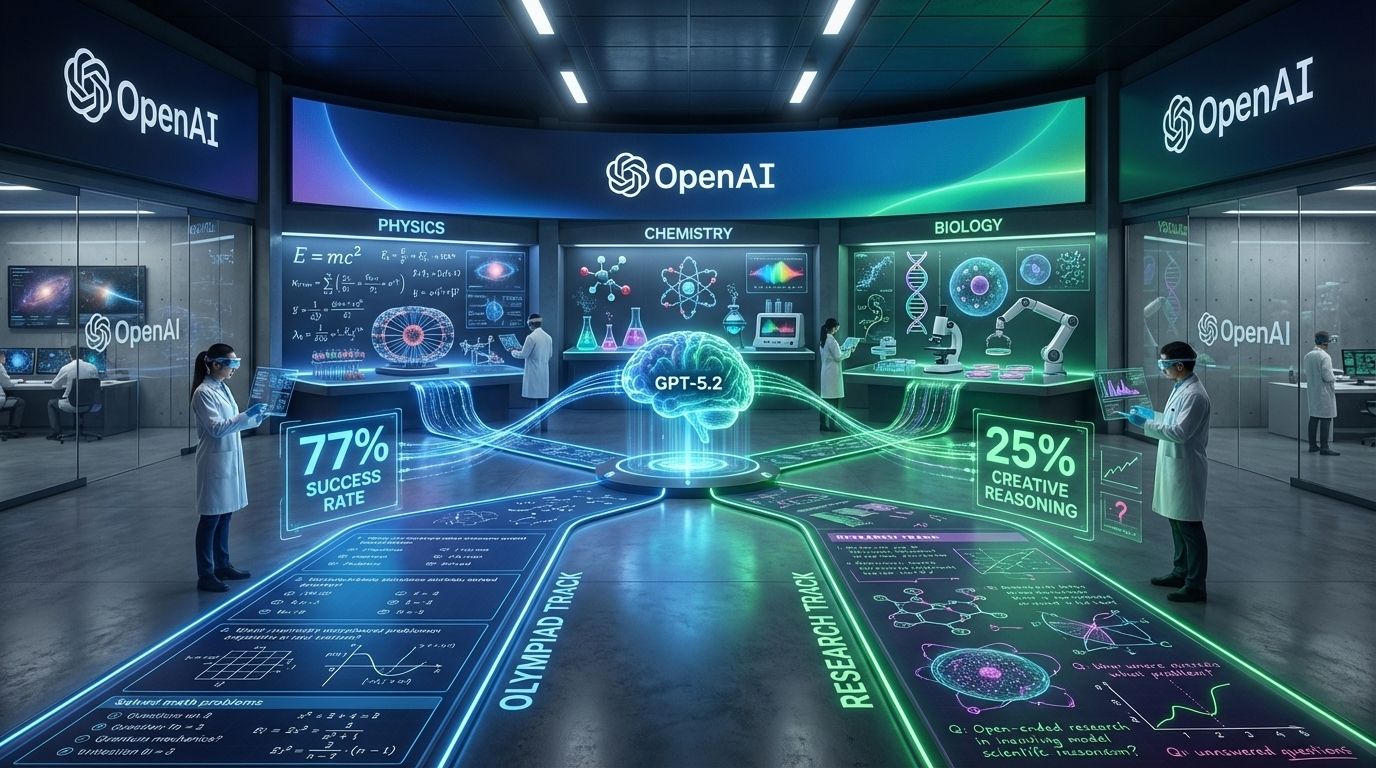
Image Credit: AIGPE®
🧠The Pulse
OpenAI launched FrontierScience, a benchmark evaluating AI’s ability to perform expert‑level reasoning across physics, chemistry and biology. It contains Olympiad‑style multiple‑choice questions and research‑level tasks. GPT‑5.2 scored 77% on the Olympiad track and 25% on the research track, highlighting both progress and limitations.
📌The Download
New benchmark introduced: OpenAI launched FrontierScience to rigorously test expert-level scientific reasoning. It goes beyond textbook recall by evaluating how models apply principles to unfamiliar scenarios across physics, chemistry, and biology, emphasizing transfer learning and cross-disciplinary understanding rather than memorization alone.
Two complementary tracks: The benchmark is split into an Olympiad track with 200 challenging multiple-choice questions and a Research track that requires open-ended problem solving. The research track demands step-by-step explanations, balancing factual recall with creativity, heuristics, and scientific judgment.
Early performance signals: GPT-5.2 achieved 77% accuracy on Olympiad questions and 25% on research tasks. While this approaches human graduate-level performance on structured problems, results show clear gaps in creative reasoning and novel hypothesis generation. Smaller models performed significantly worse.
Long-term ambition: OpenAI aims for FrontierScience to become a standard benchmark for scientific AI. By releasing the dataset openly, it encourages transparency, shared evaluation, and collaboration, accelerating progress toward AI systems that meaningfully assist real scientific discovery.
💡What This Means for You
FrontierScience gauges whether AI can truly advance scientific discovery. While results show promise, significant gaps remain. Benchmarks like this will steer funding and research priorities as labs race toward human‑level scientific reasoning. Human insight and oversight will remain essential.
AI TOOL OF THE DAY

Image Credit: ClickUp
💡 What is it?
ClickUp Agents are smart AI helpers inside ClickUp that answer questions, summarize information, and keep your work organized automatically. They act like mini-assistants that help you manage tasks without any technical skills.
🚀 Why Is It Trending?
People love it because it saves time by removing repetitive work and giving instant answers. Instead of searching through documents or tasks, you can ask the agent directly and get clear, simple updates.
✅ What Can You Do With It?
You can ask it questions about your projects, get quick summaries, and let it update tasks for you. It helps track changes, remind you of important things, and keep everything running smoothly—without you doing all the manual work.
IN AI TODAY - QUICK HITS
⚡Quick Hits (60‑Second News Sprint)
Short, sharp updates to keep your finger on the AI pulse.
Uncle Sam Wants AI Talent: Federal Fellowship Promises New Career Path: The U.S. launched a fellowship program to recruit 1,000 engineers for AI and tech projects. Fellows will work on digital services like child savings accounts, and companies such as Apple and Nvidia may hire them afterward, addressing the federal tech talent gap.
Microsoft Just Killed Manual Data Cleaning: Microsoft Fabric’s new AI Prompt in Dataflow Gen 2 lets users summarise, classify, translate and pivot data using natural‑language commands. The prompt window previews the transformation and code, supports dialect selection, and rolls out globally in mid‑December. It aims to democratise data prep for non‑programmers with adjustable columns and settings freely.
TOOL TO SHARPEN YOUR SKILLS
📈Improve Processes. Drive Results. Get Certified.

AIGPE® Certified Lean Specialist Course
Learn how to reduce waste, streamline operations, and build systems that grow with purpose.
That’s it for today’s AI Pulse!We’d love your feedback, what did you think of today’s issue? Your thoughts help us shape better, sharper updates every week. |
🙌 About Us
AI Pulse is the official newsletter of AIGPE®. Our mission: help professionals master Lean, Six Sigma, Project Management, and now AI, so you can deliver breakthroughs that stick.
Love this edition? Share it with one colleague and multiply the impact.
Have feedback? Hit reply, we read every note.
See you next week,
Team AIGPE®