- AI Pulse
- Posts
- 🧠 Can the Human Mind Control the Internet?
🧠 Can the Human Mind Control the Internet?
Brain implants are no longer experiments. They are scaling faster than anyone expected.

Rahul G. Iyer
January 02, 2026
In partnership with


Hello There!
Neuralink is moving brain implants from limited trials toward mass production and automated surgeries, which means the line between humans and computers is getting thinner while your keyboard quietly panics about job security. SoftBank has dropped a jaw-dropping $41 billion on OpenAI to fuel massive AI infrastructure and valuations, which is your cue that AI budgets are exploding and your next planning meeting might need fewer excuses and more compute awareness. Alibaba’s open-source Qwen image model just raised the bar on realistic AI visuals, which is great news because your presentations can look world-class without premium licenses or awkward stock photos that scream 2012.
Here's what's making headlines in the world of AI and innovation today.
In today’s AI Pulse
🎓 Udacity – Earn job-ready AI skills, faster and more affordable.
🟢 Gladly – Investor-grade CX insights powered by AI.
📊 Gethookd – See winning ads before you spend.
🧠 Neuralink – Scales Brain Implants To Production.
🌌 Softbank – Bets Big On OpenAI Future.
🖌️ Alibaba – Open Source Image Model Breakthrough.
⚡ Quick Hits – IN AI TODAY
🛠️ Tool to Sharpen Your Skills –🎓 AIGPE® Certified Six Sigma Yellow Belt
The coming years won’t just transform technology; they’ll reshape your home, your family life, and the control you have online.
Earn a master's in AI for under $2,500

AI skills are no longer optional—they’re essential for staying competitive in today’s workforce. Now you can earn a fully accredited Master of Science in Artificial Intelligence from the Udacity Institute of AI and Technology, awarded by Woolf, an accredited higher education institution.
This 100% online, flexible program is designed for working professionals and can be completed for under $5,000. You’ll build deep, practical expertise in modern AI, machine learning, generative models, and production deployment through real-world projects that demonstrate job-ready skills.
Learn on your schedule, apply what you build immediately, and graduate with a credential that signals serious AI capability. This is one of the most accessible ways to earn a graduate-level AI degree and accelerate your career.
Smarter CX insights for investors and founders

Join The Gladly Brief for insights on how AI, satisfaction, and loyalty intersect to shape modern business outcomes. Subscribe now to see how Gladly is redefining customer experience as an engine of growth—not a cost center.
Know what works before you spend.

Discover what drives conversions for your competitors with Gethookd. Access 38M+ proven Facebook ads and use AI to create high-performing campaigns in minutes — not days.

Image Credit: AIGPE®
🧠The Pulse
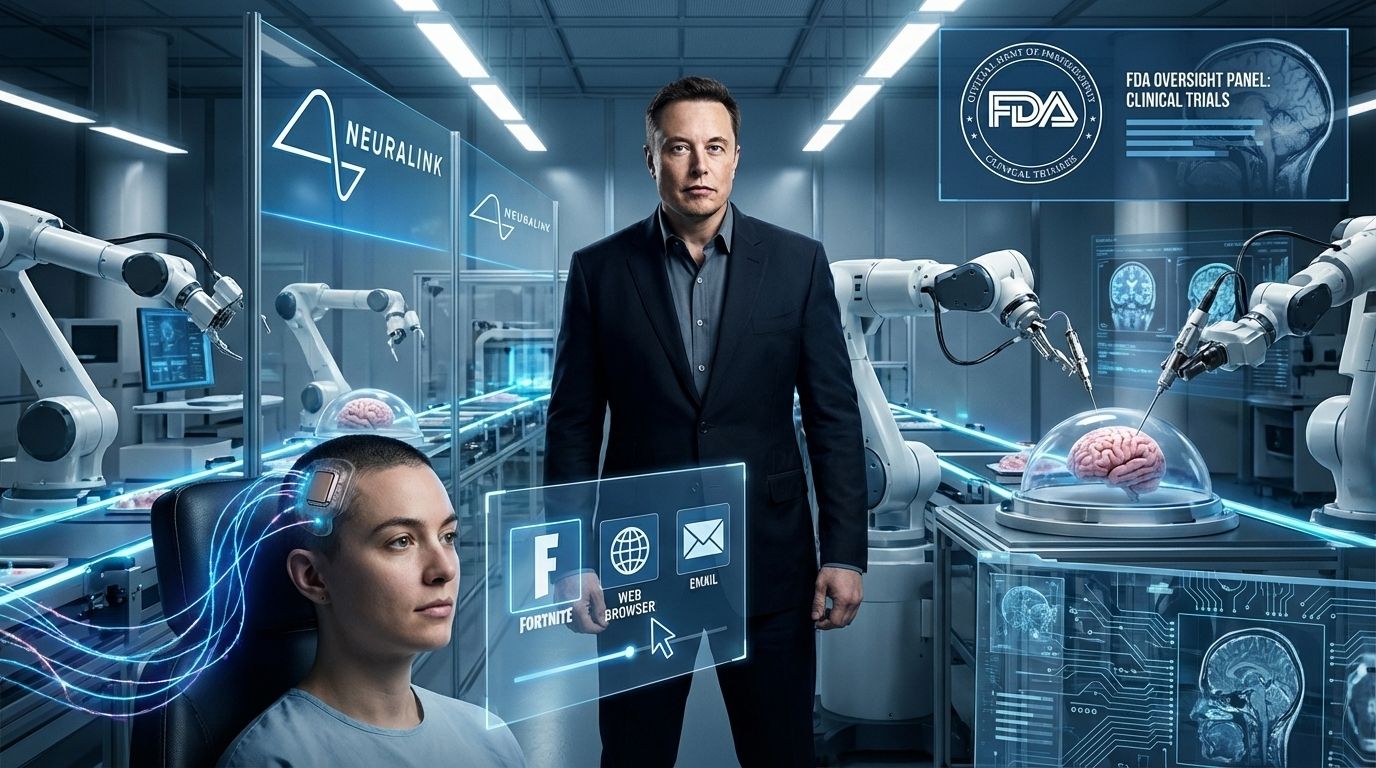
Elon Musk’s Neuralink says it will start “high‑volume production” of brain–computer interface devices and move to fully automated surgeries in 2026. The first patient used the implant in 2025 to play video games, browse the internet and control a cursor. Neuralink’s human trials began in 2024 after addressing U.S. FDA concerns. Twelve people worldwide currently have implants.
📌The Download
Scaling production: Neuralink plans to transition from limited human trials to high‑volume manufacturing of brain implants by 2026. The company also intends to automate the surgical process, moving away from manual implantation.
Early successes: Neuralink’s first patient uses the device to play games and browse online. The implant helps individuals with severe paralysis interact with digital devices using thought alone.
Regulatory milestones: Human trials began in 2024 after the U.S. Food and Drug Administration reversed an earlier rejection. Neuralink says twelve people worldwide have received implants so far.
Challenges ahead: Scaling production will require overcoming manufacturing, safety and regulatory hurdles. Skeptics caution that long‑term effects are unknown and highlight ethical questions around invasive neurotechnology.
💡What This Means for You
For professionals, Neuralink’s progress signals rapid advancement in human‑computer interfaces. While still experimental, such technologies could eventually transform assistive devices and human productivity. Workers should follow ethical debates and consider implications for privacy, accessibility and the evolving skills needed in a brain‑computer‑integrated world.

Image Credit: AIGPE®
🧠The Pulse
SoftBank has quietly completed a $41 billion investment in OpenAI, giving Masayoshi Son’s conglomerate an estimated 11 % stake. It comes on top of a $7.5 billion contribution in April and includes an additional $22.5 billion infusion plus $11 billion in co‑investments. PitchBook estimates OpenAI’s valuation between $300‑500 billion. SoftBank hopes the investment will accelerate OpenAI’s ambitious “Stargate” data‑center project and cement its role in the AI arms race.
📌The Download
Record‑breaking investment: SoftBank completed a $41 billion investment in OpenAI, one of the largest private funding rounds ever, boosting its stake to about 11 %. The deal follows an earlier $7.5 billion injection, reflecting founder Masayoshi Son’s conviction that generative AI will reshape entire industries.
Stargate ambitions: Funding will support OpenAI’s proposed “Stargate” data‑center project and other large training clusters. SoftBank’s contribution includes $22.5 billion in direct investment and $11 billion in co‑investments with partners.
Soaring valuation: PitchBook estimates OpenAI’s worth between $300 billion and $500 billion, reflecting its dominant position in generative AI models like ChatGPT and Sora. SoftBank’s bet signals rising investor confidence despite recent scrutiny of AI ethics and profitability.
Ecosystem impact: By adding OpenAI to its portfolio, SoftBank gains influence across multiple AI verticals, from cloud infrastructure to consumer applications. The move could spur rival firms and sovereign funds to increase stakes in AI startups, accelerating consolidation within the sector.
💡What This Means for You
For professionals, the massive investment underscores how quickly AI funding is escalating. Expect intensified competition for AI talent and greater pressure on companies to integrate generative models into products. Budget planning should consider rising compute costs and the potential need to partner with deep‑pocketed investors to remain competitive.

Image Credit: AIGPE®
🧠The Pulse
Alibaba’s Qwen team has released Qwen‑Image‑2512, an upgraded version of its text‑to‑image foundation model, emphasizing human realism, natural detail and improved text rendering. The model, introduced on December 30, is open‑source under Apache 2.0 and available through Qwen Chat, GitHub, Hugging Face and ModelScope. It aims to compete with proprietary models like Google’s Nano Banana Pro.
📌The Download
Enhanced realism: Qwen‑Image‑2512 reduces the “AI‑generated” look by producing more accurate human features and natural textures in landscapes and fur.
Improved text rendering: The update delivers better layout control and fidelity when combining text and images, enabling clearer composition for design and marketing uses.
Open‑source availability: The model can be accessed through Qwen Chat, GitHub, Hugging Face and ModelScope under an Apache 2.0 license, making it freely deployable without royalties.
Competitive edge: By matching or surpassing proprietary image models, Qwen‑Image‑2512 could accelerate the adoption of open‑source generative art tools and lower costs for creators. The release also signals growing Chinese participation in foundational AI research.
💡What This Means for You
As generative‑image tools become more realistic, creative professionals can leverage open‑source models without licensing fees. Expect competition between proprietary and open models to drive innovation and democratize access. Users must still verify outputs for appropriateness and avoid overreliance on synthetic images in professional work.
IN AI TODAY - QUICK HITS
⚡Quick Hits (60‑Second News Sprint)
Short, sharp updates to keep your finger on the AI pulse.
IRON Robot Debut: Chinese EV maker XPeng unveiled its Next‑Gen IRON humanoid robot with 82 degrees of freedom, a bionic spine and flexible leather skin. Powered by three AI “Turing” chips delivering 3,000 TOPS and a solid‑state battery, IRON aims to perform complex tasks and will enter mass production by late 2026.
xAI’s Colossus Expansion Signals 2 GW Supercomputer Push: Elon Musk’s AI startup xAI has purchased a third building to expand its Colossus supercomputer cluster, aiming for nearly 2 gigawatts of compute power. The Memphis‑area project could house at least one million GPUs. The new site is reportedly called “MACROHARDRR,” a playful jab at Microsoft. Construction begins in 2026.
TOOL TO SHARPEN YOUR SKILLS
📈Improve Processes. Drive Results. Get Certified.

AIGPE® Certified Six Sigma Yellow Belt
Master the basics of process improvement and problem-solving. This course helps you identify waste, reduce errors, and improve results using real-world tools.
That’s it for today’s AI Pulse!We’d love your feedback, what did you think of today’s issue? Your thoughts help us shape better, sharper updates every week. |
🙌 About Us
AI Pulse is the official newsletter of AIGPE®. Our mission: help professionals master Lean, Six Sigma, Project Management, and now AI, so you can deliver breakthroughs that stick.
Love this edition? Share it with one colleague and multiply the impact.
Have feedback? Hit reply, we read every note.
See you next week,
Team AIGPE®