- AI Pulse
- Posts
- 🫀🧬Are Robots Entering the Human Body?
🫀🧬Are Robots Entering the Human Body?
Tiny autonomous robots are being designed to operate at microscopic scales with the human body now firmly in sight.

Rahul G. Iyer
December 22, 2025

In partnership with


Hello There!
Global researchers are now sending AI-powered dual-arm robots to the Moon to work autonomously in extreme environments, which is a reminder that complex projects increasingly succeed through cross-border collaboration and smart automation rather than hero managers pulling all-nighters. At the same time, MIT has shown that you can simply talk to a robot and watch it build real objects in minutes, which should make every corporate professional smile nervously because even “I’m not technical” is slowly losing its protective powers. And if that wasn’t enough, microscopic robots cheaper than a cup of tea are learning to sense, decide, and operate on their own, quietly hinting that the future workplace may involve managing swarms of invisible systems while you are still arguing over meeting calendars.
Here's what's making headlines in the world of AI and innovation today.
In today’s AI Pulse
⚡ Attio – AI CRM that routes, automates, and grows.
✍️ Smart Brevity – Communicate clearer, faster, and with impact.
📰 1440 – The unbiased 5-minute daily news summary.
🌕 Hong Kong – Sends Dual Arm Robot.
🗣️ Speak – And Robots Build Real Objects.
🧬 Microscopic Robots – Break Size and Cost.
🧠 AI Tool of the Day – Murf AI — Turn Text Into Studio-Quality Voiceovers
⚡ Quick Hits – IN AI TODAY
🛠️ Tool to Sharpen Your Skills –🎓 AIGPE® 8D Problem Solving Specialist (Accredited)
The coming years won’t just transform technology; they’ll reshape your home, your family life, and the control you have online.
Introducing the first AI-native CRM

Connect your email, and you’ll instantly get a CRM with enriched customer insights and a platform that grows with your business.
With AI at the core, Attio lets you:
Prospect and route leads with research agents
Get real-time insights during customer calls
Build powerful automations for your complex workflows
Join industry leaders like Granola, Taskrabbit, Flatfile and more.
Six resources. One skill you'll use forever

Smart Brevity is the methodology behind Axios — designed to make every message memorable, clear, and impossible to ignore. Our free toolkit includes the checklist, workbooks, and frameworks to start using it today.
Fact-based news without bias awaits. Make 1440 your choice today.
Overwhelmed by biased news? Cut through the clutter and get straight facts with your daily 1440 digest. From politics to sports, join millions who start their day informed.

Image Credit: AIGPE®
🧠The Pulse
The Hong Kong University of Science and Technology (HKUST) will lead the “Hong Kong Operation Robot” project for China’s Chang’E‑8 lunar mission. The initiative unites global institutions to build a dual‑arm robot and mobile charging station, backed by an AI‑powered framework for real‑time perception and autonomous planning.
📌The Download
Global lunar mission — HKUST, under the China National Space Administration, will coordinate international partners through the Hong Kong Space Robotics and Energy Center (HKSREC). The robot will contribute to the Chang’E‑8 mission scheduled for 2029.
Dual‑arm robot & station — The robot includes dual arms (a first for deep‑space exploration), a mobile charging station and dexterous operations. It can deploy instruments, collect samples and transport sensors across the lunar surface.
AI operational framework — HKUST is developing an AI‑powered system that integrates machine learning with ground stations and the robot for real‑time perception, path planning and dynamic autonomy. This is crucial for navigation in the Moon’s rugged terrain and extreme temperatures.
Research & innovation hub — The HKSREC fosters cross‑institutional collaboration across Hong Kong, mainland China and overseas. It aims to build foundational capabilities in space robotics, involving over 100 researchers and driving innovation across AI, materials science and thermal engineering.
💡What This Means for You
Ambitious international projects are bringing advanced robotics to space. Professionals should recognize that dual‑arm manipulators and AI‑powered autonomy could soon transition from lunar missions to terrestrial applications. Collaborative research hubs may become vital partners for organizations looking to test AI and robotics in extreme environments.
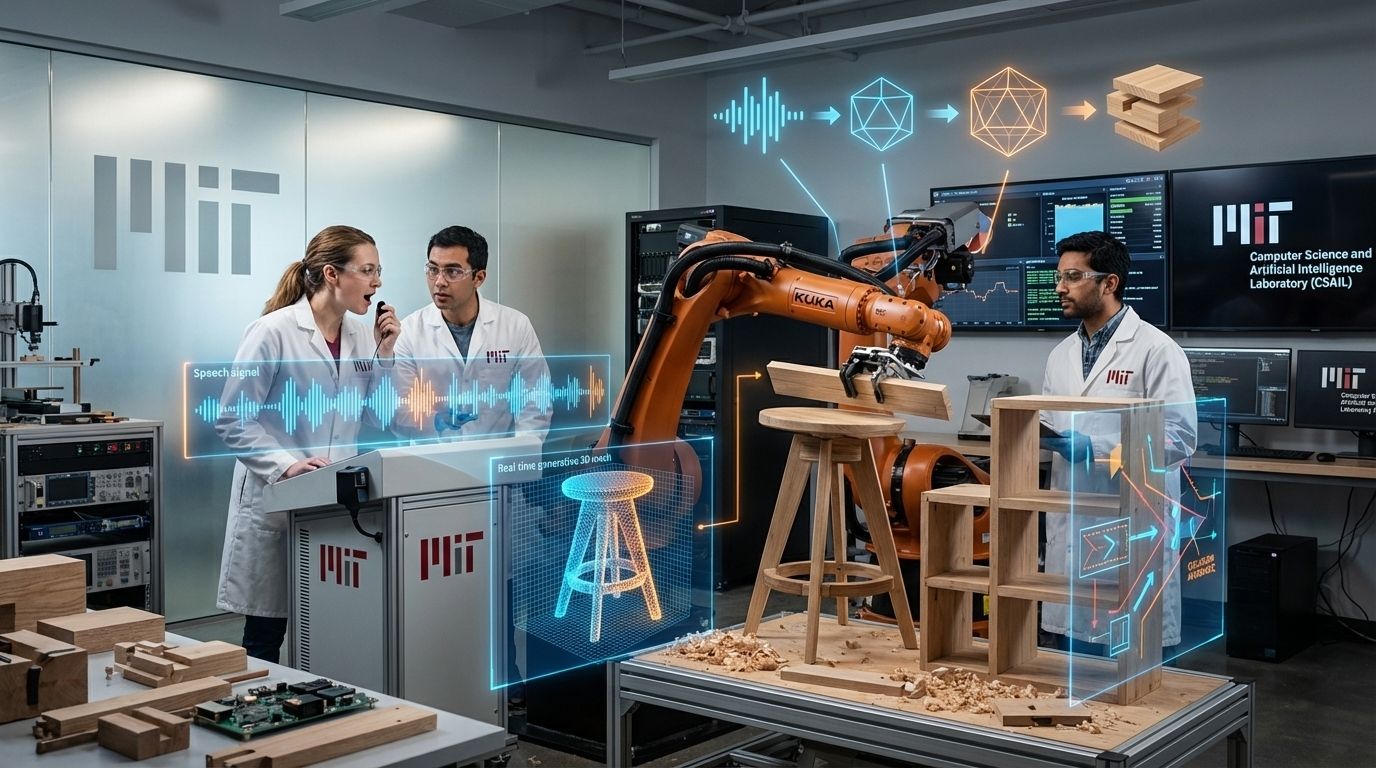
Image Credit: AIGPE®
🧠The Pulse
MIT researchers developed a “speech‑to‑reality” system that lets users verbally instruct a robotic arm to build furniture and other objects. The workflow combines speech recognition, generative 3D modeling, voxelization and automated path planning, enabling assembly of stools, shelves and chairs in minutes.
📌The Download
Speech-to-reality system: A human tells the robot, “I want a simple stool,” and the system interprets the speech, designs the object, and instructs a robotic arm to build it from scratch.
AI pipeline integration: The workflow combines a large language model for speech recognition with generative AI that creates a 3D mesh, then applies voxelization and geometric processing for real-world robotic assembly.
Fast assembly and reuse: Objects are assembled within minutes rather than hours, and modular components can be disassembled, reconfigured, and reused to reduce material waste and enable rapid experimentation.
Future enhancements: Researchers aim to strengthen weight-bearing joints, add intuitive gesture control, and deploy coordinated mobile robots capable of constructing larger structures, customized furniture, and adaptive assemblies across varied environments at architectural scales while improving reliability, safety, learning feedback, collaboration, transportability, and long-term system autonomy for broader industrial, educational, and consumer adoption worldwide through scalable open design frameworks globally.
💡What This Means for You
Voice‑controlled robotics could transform design and manufacturing. Professionals without CAD or coding experience may soon create physical products by talking to a robotic system. Expect a shift toward rapid, accessible fabrication and a need to understand the interface between natural language processing, generative AI and physical assembly.

Image Credit: AIGPE®
🧠The Pulse
Penn Engineering researchers built the world’s smallest fully programmable, autonomous robots, microscopic swimmers just 200×300×50 micrometers. Powered by light and costing about a penny each, the robots carry tiny computers, can sense temperature and navigate, and operate for months without external control.
📌The Download
Microscopic robotics: Each robot measures roughly 200 × 300 × 50 micrometers, smaller than a grain of salt, and operates untethered without magnetic fields, external power cables, or joystick control.
Programmable autonomy: Embedded microscopic computers let each robot execute complex motion patterns, sense local temperature changes, make decisions, and dynamically adjust navigation behavior in response to environmental conditions.
Light-powered and inexpensive: The robots run on light, can function for months without maintenance, and cost about one penny each, enabling economical mass deployment at unprecedented scales.
Medical and manufacturing potential: Researchers foresee uses ranging from monitoring cellular health and targeted diagnostics to assembling microscale devices, materials, and sensors, opening an entirely new frontier for autonomous machines operating invisibly within complex systems across biology, electronics, logistics, research laboratories, and future hybrid manufacturing ecosystems worldwide with programmable coordination, scalability, resilience, and minimal environmental disruption over extended operational lifetimes without centralized supervision or infrastructure.
💡What This Means for You
These micro‑robots could revolutionize fields from medicine to electronics. Professionals should anticipate future products and services that integrate swarms of microscopic devices for sensing, analysis or micro‑assembly. Awareness of microscale physics and light‑powered control systems will be important.
AI TOOL OF THE DAY

Image Credit: Murf AI
💡 What is it?
Murf AI is a text-to-speech tool with over 200 natural voices in 20+ languages and accents. It lets you control tone, pitch, speed, and emphasis so your scripts sound human, not robotic. Everything runs online with an easy-to-use editor.
🚀 Why Is It Trending?
Voice-overs usually need recording equipment and hours of editing. Murf AI changes that by delivering studio-level results in minutes to creators, educators, and businesses. Its wide voice library, customization options, and realistic delivery are making it a go-to for content creators worldwide.
✅ What Can You Do With It?
Convert scripts into polished voiceovers for training, marketing, or explainer videos. Add narration to podcasts or YouTube content. Experiment with different accents and tones to match your audience—export audio instantly without needing recording gear.
IN AI TODAY - QUICK HITS
⚡Quick Hits (60‑Second News Sprint)
Short, sharp updates to keep your finger on the AI pulse.
China Launches an AI Security Vulnerability Database: China’s state‑owned CAICT unveiled the CAIVD, a national security vulnerability database focused on AI systems. The database will catalog weaknesses in AI products, coordinate disclosures and standardize remediation efforts to protect critical infrastructure.
Amazon’s AI Chief Departs as Teams Are Restructured: Rohit Prasad, Amazon’s senior vice‑president and head of its artificial general intelligence division, is stepping down. Amazon will merge AGI, chip and quantum computing teams under AWS executive Peter DeSantis to foster tighter hardware‑software integration.
TOOL TO SHARPEN YOUR SKILLS
📈Improve Processes. Drive Results. Get Certified.

AIGPE® 8D Problem Solving Specialist Certification
Build expertise in solving complex problems with a structured, step-by-step approach. Learn to uncover root causes, drive corrective actions, and prevent issues from returning. Strengthen your skills to lead teams and deliver lasting improvements.
That’s it for today’s AI Pulse!We’d love your feedback, what did you think of today’s issue? Your thoughts help us shape better, sharper updates every week. |
🙌 About Us
AI Pulse is the official newsletter of AIGPE®. Our mission: help professionals master Lean, Six Sigma, Project Management, and now AI, so you can deliver breakthroughs that stick.
Love this edition? Share it with one colleague and multiply the impact.
Have feedback? Hit reply, we read every note.
See you next week,
Team AIGPE®