- AI Pulse
- Posts
- 🚨 Apple Dumped OpenAI for Google?
🚨 Apple Dumped OpenAI for Google?
Siri’s AI brain just changed hands.

Rahul G. Iyer
January 14, 2026

In partnership with


Hello There!
Apple quietly rewired Siri by choosing Google’s Gemini over OpenAI, and for corporate professionals this is a reminder that even the biggest tech marriages can end suddenly so maybe do not get too emotionally attached to your AI vendor. Meta then turned the volume up by announcing plans to build gigawatt-scale AI infrastructure powered by nuclear energy, which is a polite way of saying your future AI budget may depend as much on electricity as on strategy decks. Finally, affordable robotic hands stole the spotlight by making dexterous automation mainstream, and for professionals this means the line between humans and machines just got blurrier so it might be time to make friends with the robot before it learns to use chopsticks better than you.
Here's what's making headlines in the world of AI and innovation today.
In today’s AI Pulse
🎙️ Wispr Flow – Turn voice into better AI prompts.
🧠 The Code – Tech insights engineers read weekly.
📊 Gethookd – See winning ads before you spend.
📱 Apple – Picks Google Gemini Over OpenAI.
🏭 Meta – Bets Gigawatts To Build Superintelligence.
🤖 Affordable Robot – Hands Bring Dexterity Mainstream.
⚡ Quick Hits – IN AI TODAY
🛠️ Tool to Sharpen Your Skills –🎓 AIGPE® Al-Powered WBS Specialist Certification (with ChatGPT) I WBS
The coming years won’t just transform technology; they’ll reshape your home, your family life, and the control you have online.
Better prompts. Better AI output.
AI gets smarter when your input is complete. Wispr Flow helps you think out loud and capture full context by voice, then turns that speech into a clean, structured prompt you can paste into ChatGPT, Claude, or any assistant. No more chopping up thoughts into typed paragraphs. Preserve constraints, examples, edge cases, and tone by speaking them once. The result is faster iteration, more precise outputs, and less time re-prompting. Try Wispr Flow for AI or see a 30-second demo.
What 100K+ Engineers Read to Stay Ahead

Your GitHub stars won't save you if you're behind on tech trends.
That's why over 100K engineers read The Code to spot what's coming next.
Get curated tech news, tools, and insights twice a week
Learn about emerging trends you can leverage at work in just 10 mins
Become the engineer who always knows what's next
Know what works before you spend.

Discover what drives conversions for your competitors with Gethookd. Access 38M+ proven Facebook ads and use AI to create high-performing campaigns in minutes — not days.

Image Credit: AIGPE®
🧠The Pulse
Apple signed a multi‑year deal with Google to power its revamped Siri and Apple Intelligence with the Gemini model, shifting away from OpenAI. The partnership briefly pushed Alphabet’s market value above $4 trillion and drew criticism from Elon Musk about concentrating AI power.
📌The Download
Gemini deal – Apple struck a multi‑year licensing pact with Google for Gemini to power Siri, paying Google to run generative AI on iPhones. The deal replaces OpenAI’s GPT and raises questions about its role.
Alphabet surge – The partnership briefly pushed Alphabet’s market cap above $4 trillion. Analysts said the deal highlights Google’s AI leadership and could strengthen its cloud and search units. The surge signals investor confidence in Google’s ability to monetize generative AI across platforms.
Power worries – Elon Musk warned that the exclusive tie‑up gives too much power to a single company. Critics argue Apple’s reliance on Google centralises control of generative AI and heightens antitrust concerns amid intensifying competition.
OpenAI demoted – By choosing Gemini, Apple relegates OpenAI to a secondary role. Analysts note the move reflects Apple’s focus on privacy and on‑device processing and will intensify the rivalry between Google and OpenAI even further.
💡What This Means for You
For professionals, Apple’s pivot toward Google’s AI highlights how quickly partnerships can reshape power dynamics. Expect more cross‑company alliances and heightened scrutiny over who controls your data. Evaluate AI vendors carefully to avoid lock‑in and ensure transparency in how models are trained and monetised, and adapt procurement strategies accordingly today.

Image Credit: AIGPE®
🧠The Pulse
Mark Zuckerberg unveiled Meta Compute, an ambitious initiative to build tens to hundreds of gigawatts of AI computing capacity, co‑led by infrastructure chief Santosh Janardhan and investor Daniel Gross. Meta is signing nuclear‑power deals and pitching the project as the foundation for superintelligence despite energy and regulatory concerns.
📌The Download
Massive compute ambition – Mark Zuckerberg unveiled Meta Compute, a project to build tens to hundreds of gigawatts of AI capacity. Co‑led by infrastructure chief Santosh Janardhan and investor Daniel Gross, it aims to support superintelligent models and data‑intensive research.
Nuclear power deals – Meta signed agreements with Vistra to buy power from Illinois nuclear plants and is exploring advanced nuclear partners. Zuckerberg said carbon‑free baseload energy is critical to scale AI without overwhelming grids, ensuring reliability and stability.
Superintelligence push – Meta views Meta Compute as essential to developing artificial general intelligence. Building proprietary infrastructure reduces dependence on external clouds and accelerates breakthroughs in generative models for Meta.
Resource concerns – Critics warn that building tens to hundreds of gigawatts of data centres will strain global energy supply and deepen inequality. Zuckerberg acknowledged challenges and said Meta will work with governments and industry to address environmental and regulatory hurdles.
💡What This Means for You
Meta Compute shows the scale of investment needed for next‑generation AI. Expect infrastructure and energy partnerships to become strategic, and know that computing limits could shape AI availability. Understanding power sources, sustainability and regulatory impacts will be crucial when deploying large models or choosing providers in coming years.
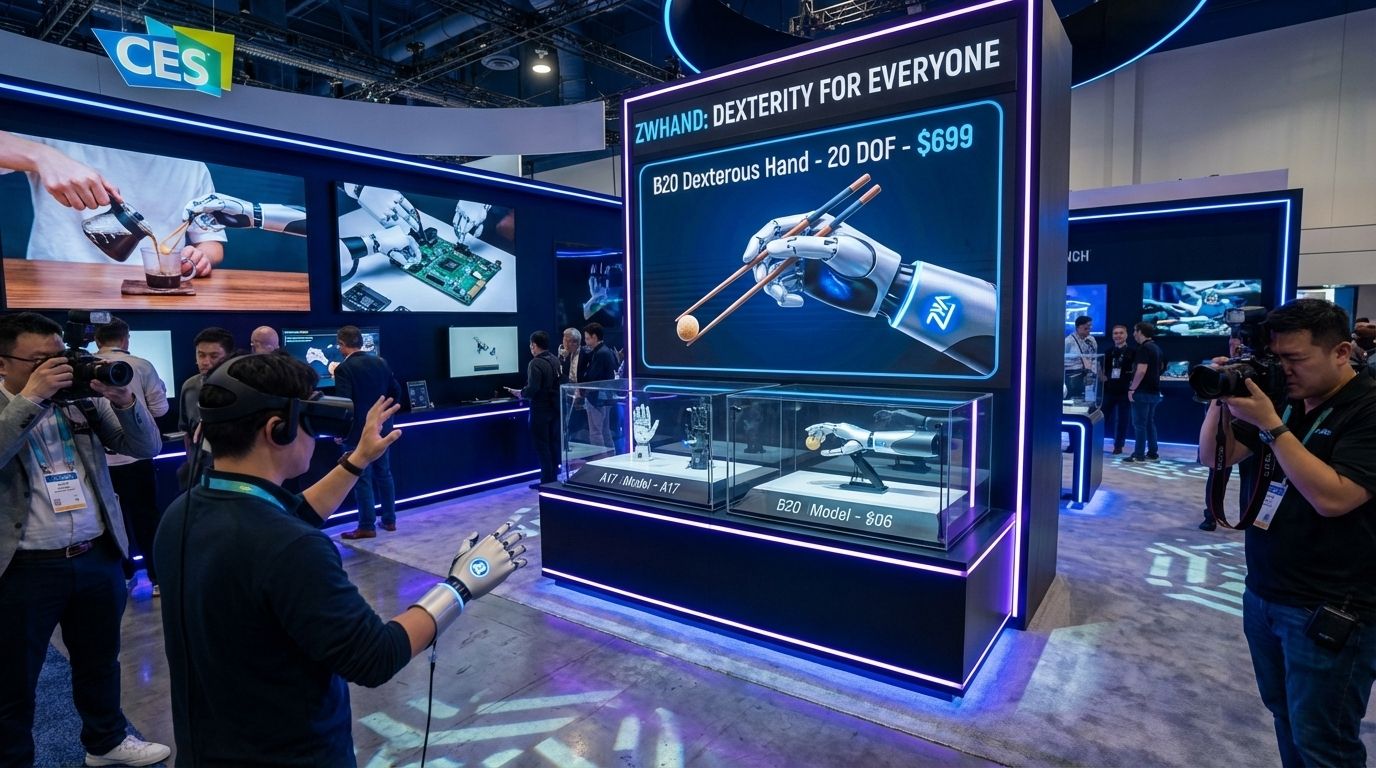
Image Credit: AIGPE®
🧠The Pulse
At CES 2026, Chinese startup ZWHAND unveiled a lineup of mass‑produced robotic hands led by the 20‑DOF B20 Dexterous Hand. The company also introduced mid‑range and entry‑level models and showcased dexterous tasks like using chopsticks, signalling affordable, plug‑and‑play robotic manipulation is reaching mainstream, spanning $699 to $7,000 with VR teleoperation.
📌The Download
Flagship hand – At CES 2026 ZWHAND debuted its mass‑produced B20 Dexterous Hand with 20 degrees of freedom, weighing 600 g and matching an adult palm. It suits high‑end humanoid robots and research, offering manipulation and engineered for plug‑and‑play use and durability.
Tiered lineup – A tiered lineup includes the 17‑DOF A17 for logistics and the 6‑DOF B06 for entry‑level use. Prices range from $699 to $7,000, opening robotic hands to hobbyists, educators and professionals while balancing dexterity and cost.
Immersive demos – Live demos showed the hands grasping objects, executing fine movements and integrating easily with other systems. Users could teleoperate via Bluetooth or VR, while built‑in sensors enable autonomous adaptation and durability, demonstrating tasks like chopstick use.
Collaboration future – ZWHAND says this lineup marks a milestone for embodied AI. Scalable dexterity could usher in collaborative robots that handle delicate tasks alongside humans in factories, warehouses and homes.
💡What This Means for You
Accessible dexterous robot hands mean more devices will grasp and manipulate objects. For professionals, this opens opportunities to automate intricate tasks in labs, warehouses and home care. Get ready to integrate plug‑and‑play end effectors, manage teleoperation interfaces and design workflows combining human and robot dexterity safely and efficiently at scale.
IN AI TODAY - QUICK HITS
⚡Quick Hits (60‑Second News Sprint)
Short, sharp updates to keep your finger on the AI pulse.
Authentic Brands’ AI Agents: Fashion Meets Gemini: Authentic Brands Group, owner of labels like Reebok and Elvis, partnered with Google Cloud to build Authentic Intelligence. The AI platform uses Gemini and Vertex AI to create specialised agents for business development, design, licensing and legal tasks, boosting returns and accelerating work across its portfolio across global brands now.
Defender Gets Smarter: AI Now Tells You Which Threats Matter: Microsoft Defender XDR has a new AI feature that assigns priority scores and colours to security incidents. The model factors in severity, asset criticality and threat intelligence, surfacing high‑risk alerts first. A summary pane explains why incidents are ranked high. The public preview is open to customers, improving analyst efficiency.
TOOL TO SHARPEN YOUR SKILLS
📈Improve Processes. Drive Results. Get Certified.
AIGPE® AI-Powered WBS Specialist Certification (with ChatGPT)
Learn how to structure projects with clarity, manage scope, and raise your planning game. This WBS Specialist certification gives you the skills to organize work into manageable parts and lead with precision.
That’s it for today’s AI Pulse!We’d love your feedback, what did you think of today’s issue? Your thoughts help us shape better, sharper updates every week. |
🙌 About Us
AI Pulse is the official newsletter of AIGPE®. Our mission: help professionals master Lean, Six Sigma, Project Management, and now AI, so you can deliver breakthroughs that stick.
Love this edition? Share it with one colleague and multiply the impact.
Have feedback? Hit reply, we read every note.
See you next week,
Team AIGPE®